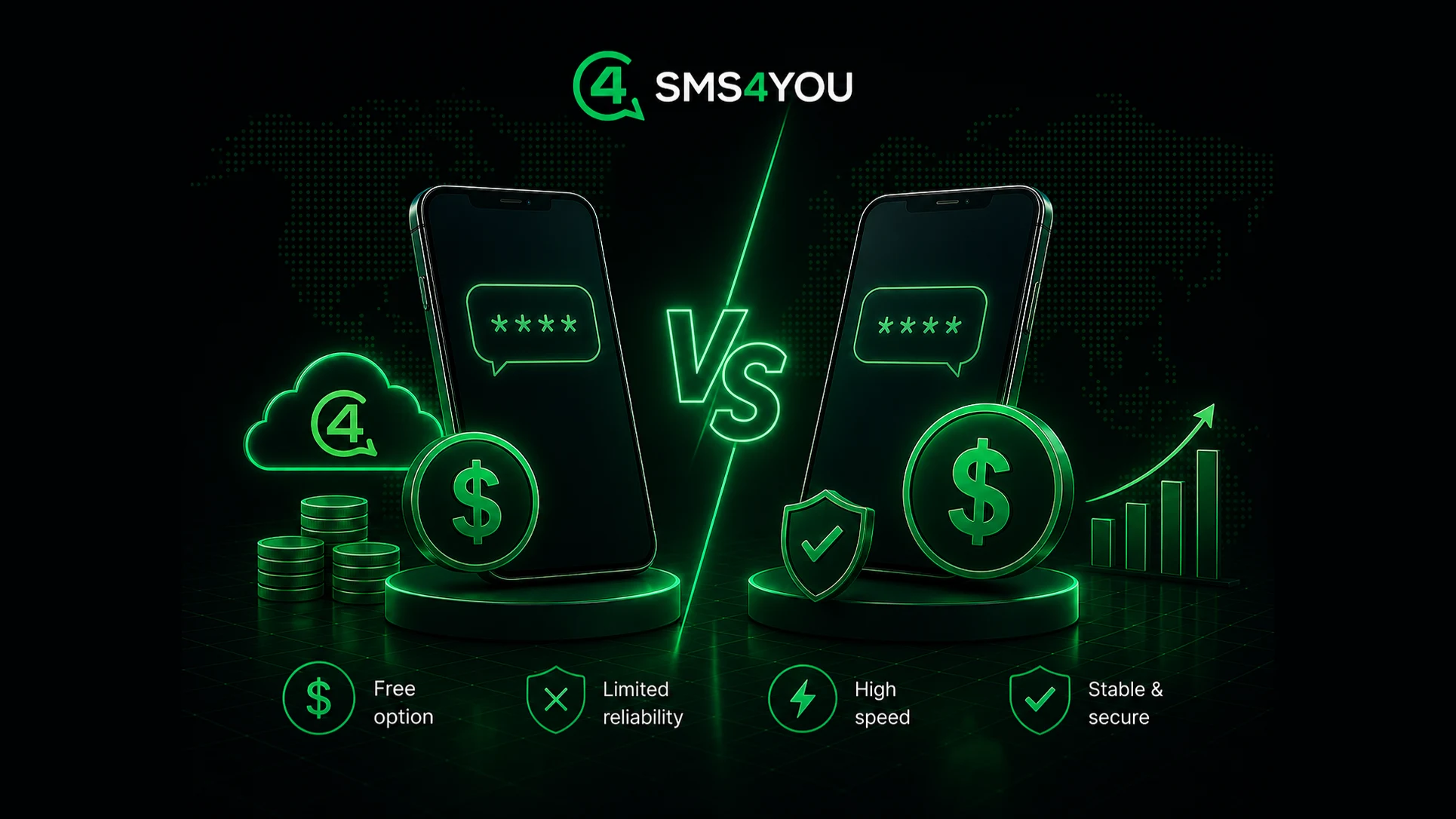
Free vs. Paid SMS Services: Which to Choose for Receiving Verification Codes
When you need to receive an SMS code without a personal SIM card, you face a choice: find a free public number or pay for a rental through a specialized service. The first option is appealing because it costs nothing, while the second promises reliability and privacy. But is saving money on verification really worth it? Let’s break down how these two approaches differ, in which situations each is justified, and why access to a secure personal account often proves to be the deciding factor.
Two Approaches to Receiving SMS
Free SMS services publish pools of virtual numbers that are publicly accessible. Any visitor can take a number, enter it into the registration form, and view the code in the public message feed. No authorization, no payment—just a browser and a wait.
The downside of this accessibility is that dozens of people see the number at the same time, and the received code is available to everyone. Control over the created account is effectively shared with an undefined group of people. Plus, popular platforms have long blacklisted public pools, so the numbers either don’t accept SMS or the account gets blocked shortly after registration.
Paid SMS services operate on a rental model. You receive a cloud-based number assigned exclusively to you for the paid period. No one else sees this contact or has access to incoming messages. All SMS messages are displayed in your private personal account—a space accessible only to you. This approach eliminates the issue of public exposure and ensures that the number isn’t compromised by mass usage.
Comparison Table
Criterion | Free services | Paid services |
|---|---|---|
Cost | Zero | Minimum fee per SMS |
Privacy | None: codes are visible to all visitors | Full: code is known only to the renter |
Number availability | Limited pool, many on platform blocklists | Wide selection of countries and carriers |
Delivery reliability | Unpredictable, frequent delays | High, dedicated SMS gateways |
Risk of account suspension | High: platforms monitor public pools | Low: private numbers are less likely to be sanctioned |
Technical support | None | 24/7 |
Reuse | Not possible | Possible within the rental period |
When a free number is sufficient
There is a narrow range of scenarios where a public number is justified. This includes registering on a platform you don’t value and are willing to lose at any moment. Or testing an interface where no valuable data is used. Or a situation where payment methods are unavailable, but activation is needed urgently and for a single use.
In all these cases, it’s important to remember: if the service requests re-verification or blocks your account because of a public number, you won’t be able to regain access. A free SMS service is always a risky compromise.
When a paid number is necessary
A paid option becomes the only choice if you’re registering an email, messenger, or social media account for long-term use. Or if the account is linked to work, a project, or financial transactions. It’s also necessary for multi-step verification with multiple codes. Plus, when privacy and protection against interception are important.
Finally, when you need a guarantee that the number won’t end up on the platform’s blacklists. A paid SMS service isn’t just about receiving messages—it’s a tool for managing digital security.
How to receive SMS via a paid service
Register on the provider’s website and top up your balance.
In the catalog, select the desired platform and the country of the number.
Specify the rental type: one-time or for a fixed term. The system will select the contact and display it in your personal account.
Copy the number, enter it into the target service’s form, and request the code.
Return to your personal account and retrieve the received message.
Your entire transaction history is stored there, which is convenient for reviewing while the rental is active.
FAQ
Are there any completely anonymous free SMS services?
Anonymity in public pools is relative. Your actions aren’t tied to your identity, but the code is visible to many outsiders. This isn’t anonymity, but rather the collective use of a single identifier.
Why is a paid service safer?
The number is assigned exclusively to you, and the code is not published publicly. Providers use encryption and protect your personal account from unauthorized access.
Can you combine both approaches?
Yes. Some users use free numbers for testing and paid ones for important activations. The main thing is not to enter payment details into accounts created through public pools.
What should you do if a free number doesn’t receive SMS messages?
Try another number from the pool. If that doesn’t work either, the platform has likely blocked the entire range. The only option left is to rent a paid number.
Can I get a refund if the code doesn’t arrive?
Yes. In the event of a technical glitch, the funds are automatically refunded to your balance. With free services, you’re just wasting your time.
Conclusion
Choosing between a free and a paid SMS service is a choice between risk and reliability. Public pools are only suitable for short-term experiments where you don’t mind losing access. When it comes to a permanent account, a working project, or protecting personal data, it makes sense to use a paid service.
SMS4YOU provides exactly that: private number rental, instant code delivery, 24/7 support, and transparent management via your personal account. Don’t risk what matters. Choose paid reliability and maintain control over your digital life. Log in to your personal account and see for yourself that professional SMS verification is fast, affordable, and secure.